Seismic Data Interpretation
Expert analysis to identify geological structures and assess reservoir potential
Why this service is important
Seismic data interpretation translates the results of acquisition and processing into knowledge about geological structures, horizons, faults, stratigraphic relationships and parameters relevant to the assessment of reservoir, geothermal, storage or investment potential.
GT’s offer
GT provides specialist seismic data interpretation services, combining the team’s experience, geological and geophysical expertise, modern interpretation tools and the integration of seismic, well log and geological data.
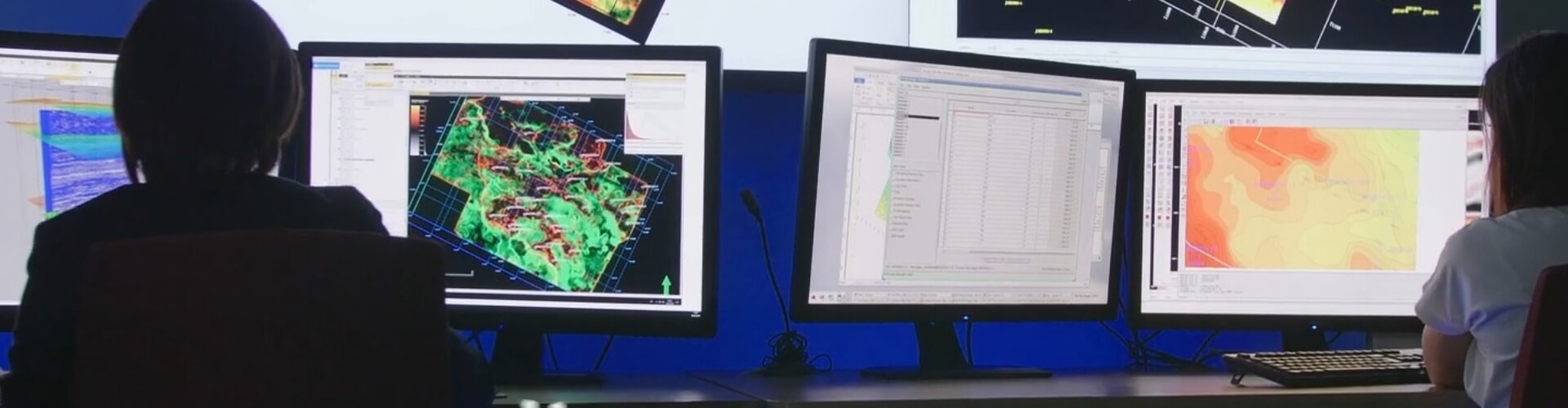
The work is carried out by the GT’s Seismic Data Interpretation Centre, which has a full range of hardware and software facilities, as well as specialised environments for structural and stratigraphic interpretation, attribute analysis, inversion, quantitative interpretation (QI) and geological and reservoir modelling.
These services are provided on both the domestic and international markets. They include, amongst other things, the interpretation of deep reflection seismic data for hydrocarbon reservoirs, underground gas and CO₂ storage, and geothermal energy, as well as the characterisation of shallower subsurface layers for offshore wind energy, nuclear energy and critical infrastructure.
Technologies and operational advantages
The scope of work includes structural and stratigraphic interpretation, the identification of horizons and faults, analysis of structural geometry, correlation of seismic data with geological and well data, and analysis of seismic attributes.
For tasks requiring detailed interpretation, GT utilises spectral decomposition, geometric attributes, AVO/AVA, seismic inversion, quantitative interpretation (QI), geological and reservoir modelling, rock physics, and solutions supported by automation and machine learning.
Value for the client
The client receives practical geological knowledge to support the assessment of reservoir potential, the selection of well locations, the documentation of reserves, the planning of further work, and the making of technical and investment decisions.
Scope of services
- interpretation of 2D and 3D reflection seismic data
- structural and stratigraphic interpretation
- identification of horizons, faults, discontinuities and fracture zones
- correlation of seismic data with geological and well data
- attribute analysis, AVO/AVA, seismic inversion and quantitative interpretation (QI)
- Data interpretation for hydrocarbon reservoirs, geothermal energy, storage and CCS
- Interpretation of UHR and refraction tomography data for offshore projects
- Interpretation studies for infrastructure, nuclear energy and offshore wind energy